Trying to decode HOA communities in Meridian? You are not alone. If you are relocating, buying your first home, or comparing newer subdivisions, HOA amenities and rules can feel like a moving target. The good news is that once you know what to look for, it gets much easier to tell whether a community fits your budget, lifestyle, and long-term plans. Let’s dive in.
Why HOAs Matter in Meridian
Meridian’s growth has been shaped by long-term planning around neighborhood design, residential standards, and pathway connectivity. The city’s planning framework also supports connections between homes, parks, schools, businesses, and recreation.
That helps explain why so many Meridian subdivisions are set up as planned communities with shared spaces, walking paths, and detailed HOA rules. If you are shopping in Meridian, there is a good chance the neighborhood experience will include both amenities and association guidelines.
Common HOA Amenities in Meridian
In Meridian, HOA amenities can range from simple upkeep services to full lifestyle packages. Some communities focus on outdoor recreation, while others keep things more basic and practical.
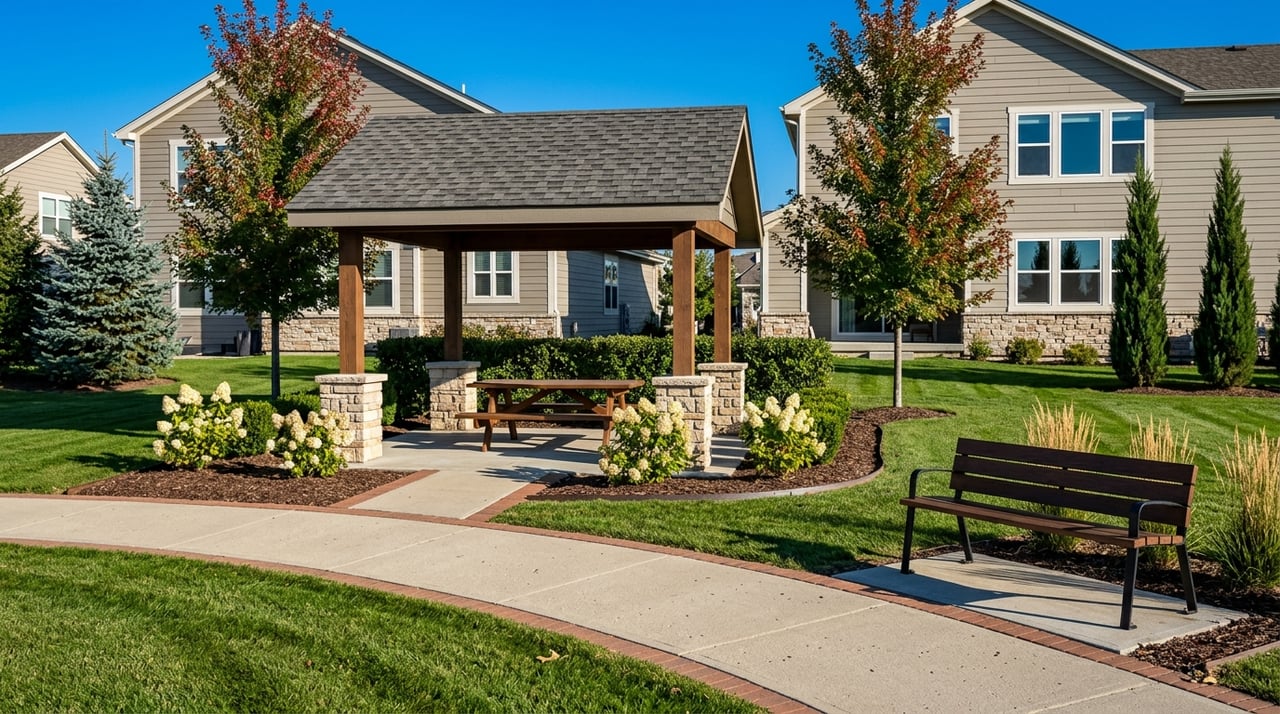
Amenity-rich communities often highlight pools, clubhouses, parks, playgrounds, green space, and walking paths. These features can make day-to-day living more convenient, especially if you want recreation close to home.
Amenity-heavy community examples
Tuscany is one of the clearest examples of a feature-rich Meridian HOA. It advertises a clubhouse, four pools, parks, playgrounds, lakes, water features, pocket parks, miles of walking paths, and a process for reserving the clubhouse.
Century Farm also leans into shared amenities. The community offers walking paths connected to Hillsdale Park, the YMCA, a school, playgrounds, a community barn, a pool, and common areas.
Quartet includes a pool, interconnected walking paths, green spaces, and a playground. Sagecrest lists a seasonal pool, fitness center, and clubhouse, while Settlers Bridge includes a heated pool, walking paths, common areas, and two playgrounds. Oakhurst lists a community pool and common area.
Simpler HOA community examples
Not every Meridian HOA comes with a long amenity list. Some communities are more focused on maintenance, parking, or convenience.
Masters highlights assigned parking and HOA-maintained landscaping. Intrepid emphasizes assigned covered parking, and Rosera lists covered parking and freeway access. Spyglass stands out more for large lots and mature landscaping than for shared recreational amenities.
How HOA Dues Can Vary
One of the biggest surprises for buyers is how much HOA dues can differ from one Meridian community to another. There is no single standard rate, and the fee structure may be annual, monthly, or include separate charges.
Current Meridian examples show annual dues as low as $150 plus $231 in annual irrigation dues, and as high as $725 annually. Other examples include monthly dues of $170, $200, $259, and $300, along with yearly dues of $1,350.
What dues may reflect
In general, communities with more amenities often need more ongoing funding. Pools, clubhouses, paths, playgrounds, and common-area maintenance all create recurring costs.
That said, higher dues do not always mean more visible amenities. Some simpler associations still charge meaningful dues because they manage landscaping, parking, or other shared responsibilities.
What Buyers Should Review Before Making an Offer
If you are serious about a home in a Meridian HOA, the document review matters just as much as the home tour. This is where you learn what you are really agreeing to beyond the purchase price.
For resale transactions, a standard HOA document package typically includes the CC&Rs, bylaws, articles, budget, and meeting minutes. A certification questionnaire may also include the number of units, turnover date, assessment amount, and any special assessment information.
A separate demand or statement of account can show debts and violations tied to a specific property. That can help you avoid surprises late in the transaction.
Key HOA items to compare
Before you write an offer, make time to review:
- CC&Rs and community rules
- Architectural guidelines
- Dues and payment schedule
- Reserve and budget information
- Meeting minutes
- Pool or clubhouse rules
- Parking and vehicle restrictions
- Pet rules
- Rental restrictions
- Special assessments
- Transfer fees
These details can be more specific than many buyers expect. In Meridian, community pages show examples such as painting, fence, tree removal, solar panel, and roof change forms in Settlers Bridge, posted pool rules in Oakhurst, and clubhouse reservation requirements in Tuscany.
Five Questions to Ask About a Meridian HOA
When you compare communities, it helps to keep your questions simple and practical. A good HOA is not just about whether the neighborhood looks nice. It is about whether the costs and rules match how you plan to live.
1. What do the dues actually cover?
Ask whether dues pay for amenities, landscaping, irrigation, parking management, or common-area upkeep. Two neighborhoods can have similar dues but cover very different things.
2. Are there separate irrigation or special assessments?
Some associations have add-on costs beyond the main dues. A lower headline amount may not tell the whole story if irrigation charges or special assessments apply.
3. What exterior changes need approval?
If you may want to paint, replace a roof, remove a tree, install solar panels, or update fencing, check the approval requirements early. HOA architectural controls can be very detailed.
4. Do parking or rental rules affect your plans?
Parking restrictions can matter if your household has multiple vehicles, work vehicles, or guests who stay often. Rental rules also matter if you want flexibility later, even if you plan to occupy the home now.
5. Is any transfer fee clearly disclosed?
This is an important Idaho-specific point. Idaho’s Attorney General has stated that transfer fees must be explicitly disclosed in the HOA’s CC&Rs, and management companies do not have authority under Idaho law to charge transfer fees unless properly supported.
Before removing contingencies, verify the closing statement, the CC&Rs, and any HOA invoice or estoppel document. That extra review can help you catch fees that do not belong.
How to Weigh Amenities Against Long-Term Value
The best Meridian HOA community for you is not always the one with the longest amenity list. In many cases, the smarter comparison is which neighborhood offers the best mix of convenience, recurring cost, and rules for your household.
For example, if you want multiple pools, connected walking paths, and shared gathering spaces, a community like Tuscany or Century Farm may feel like a strong fit. If you prefer fewer shared features and a simpler setup, a neighborhood like Masters or Intrepid may feel more comfortable.
Think beyond the first impression
A beautiful entrance, pool, or clubhouse can be appealing during a weekend tour. But the long-term questions usually matter more than the first impression.
Ask yourself:
- Will you actually use the amenities?
- Do the dues feel reasonable for the benefits?
- Does the HOA appear financially healthy?
- Are you comfortable with the level of exterior control?
- Could parking, pool, or rental rules create friction later?
Those answers can help you choose a neighborhood that supports your day-to-day life rather than complicates it.
A Practical Approach for Meridian Buyers
If you are relocating to Meridian, HOA communities can offer a lot of convenience. Shared paths, maintained common areas, pools, and clubhouses may fit well if you want an organized neighborhood layout and built-in amenities.
At the same time, every HOA comes with tradeoffs. The right fit depends on how you balance budget, rules, maintenance expectations, and the features you will actually use.
That is where local guidance can make a real difference. When you compare communities side by side, it becomes much easier to spot which HOA adds value for you and which one may add costs or restrictions you do not want.
If you are exploring HOA neighborhoods in Meridian or relocating to the Treasure Valley, Kent Davies can help you compare communities, review the details that matter, and find the right fit with confidence.
FAQs
What amenities are common in Meridian HOA communities?
- Common Meridian HOA amenities include pools, clubhouses, playgrounds, walking paths, parks, green spaces, and common areas, though some communities focus mainly on landscaping or parking.
How much are HOA dues in Meridian, Idaho?
- Meridian HOA dues vary widely, with current examples ranging from $150 annually plus irrigation dues to monthly dues of $170, $200, $259, and $300, as well as some higher annual totals.
What HOA documents should buyers review in Meridian?
- Buyers should review the CC&Rs, bylaws, budget, meeting minutes, architectural guidelines, dues schedule, reserve information, and any documents showing special assessments, transfer fees, debts, or violations.
Do all Meridian neighborhoods with HOAs have pools or clubhouses?
- No. Some Meridian HOA communities offer extensive amenities like pools and clubhouses, while others focus on simpler benefits such as maintained landscaping, assigned parking, or covered parking.
What should buyers ask before buying in a Meridian HOA community?
- Buyers should ask what dues cover, whether separate irrigation or special assessments apply, what exterior changes need approval, whether parking or rental rules matter, and whether any transfer fee is clearly disclosed in the governing documents.